Well, first, it’s now broken.
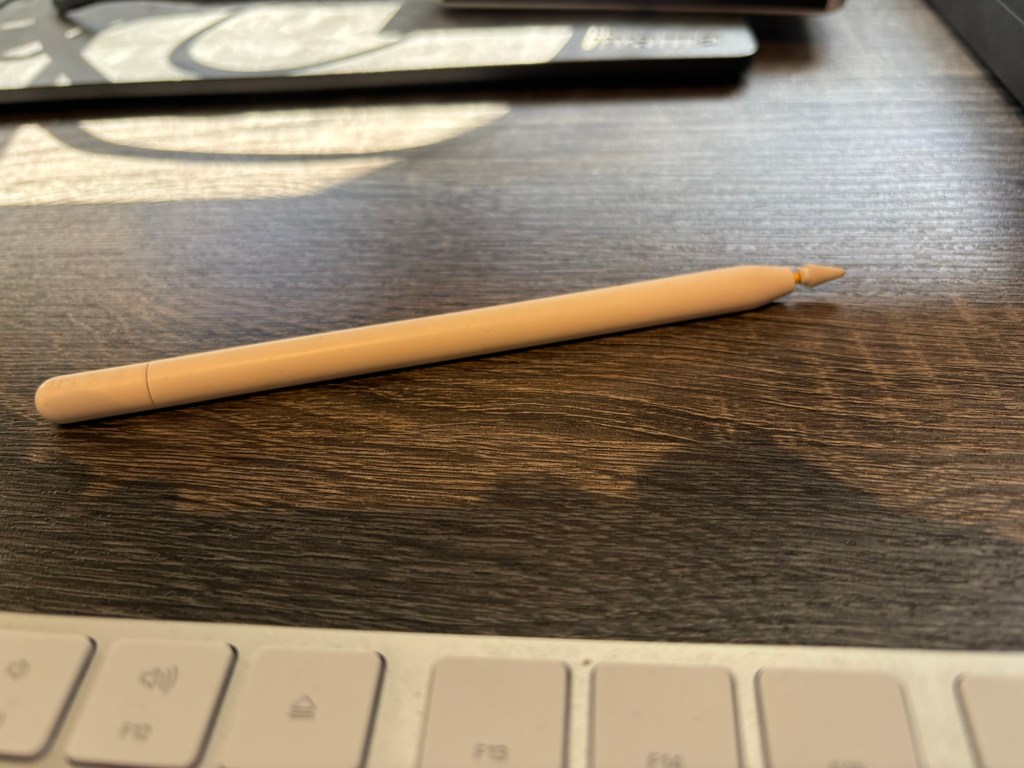
Secondly, it broke because I’d done the fool thing of attaching it magnetically to the side of the iPad – you know, the way it’s designed – but my 6-year-old son picking it up was enough to jolt the Pencil off the side of the iPad so that it fell onto our hard kitchen floor. I suspect it landed directly on the tip which is what caused it to break. No, I’ve tried screwing the tip back on, it doesn’t go; it’s actually broken.
But thirdly, here’s the thing: I’m not in the least bothered about replacing it.
Oh, sure, it would be useful occasionally. One of the chief uses for my iPad is for music-reading, a function for which the device excels beyond all reasonable expectation. Gone are the days of carrying around tonnes of music books. At present I have ~1300 PDFs in my score reading app, many of them several pages long.
And so the Pencil would come in useful for annotations of those and, sometimes, other PDFs I was working on in other apps too. I’ll sort of miss that. I guess that’s the only thing that will make me think about replacing it.
But first I’d have to always remember to have a charger cable with me, it being the ‘new’ version of the ‘first generation’ of Pencil (not the fancy ones that wirelessly charge on the side of the iPad, though I bet those suffer from many of the same problems I will here elucidate). Because that thing would never work, and then I’d realise it was because it had been sat in my bag for a while somewhere, somehow losing charge, so I’d have to plug it in basically any time I actually wanted to use it, and let it charge a bit. You don’t have to do that with real pencils. Just sharpen them occasionally, although far less often than I would have to charge the Pencil in my experience. And you get those nice clicky ones now you don’t even have to sharpen.
Was the writing experience ‘smooth’ and ‘seamless’, or whatever garbage the Apple sales page garbles out? Kinda, but everyone will tell you, it’s still curiously abstracted compared to actually writing with a physical pen on physical paper. And sure, you can also erase things easily, move annotations about afterwards – all good – which means less commitment in the long run. Which is actually a drawback. With actual pen and paper, you’re committed. What goes on the page stays on the page. With ‘digital’ ‘writing’, nothing is permanent, so what does it mean to you? Not so much. And it wasn’t that smooth and seamless, honestly.
An Apple Pencil will set you back £100-200 depending on what model you get, and the tips need replacing every now and then. It needs charging before it can work, often falls off the iPad in your bag (if I had £1 for every time I’d thought to myself ‘Where actually is my Apple Pencil?’ I’d have enough to buy a replacement right now) and apparently can fall off mid-air as well and break when it lands on the floor. It creates things in the abstract, with the results being less tangible and permanent than anything that might exist in the real world.
A Staedler pencil costs peanuts, doesn’t break irreparably when you drop it and doesn’t need recharging – you will just need to sharpen it every now and then, a curiously satisfying and thoughtful pastime. What it creates can be erased, sure, but you’re more committed to what you create with it, because it exists in the physical world, a lasting record of your expression.
So, I’ll probably mope a tiny bit every time I want to quickly annotate a PDF on my iPad, but then I’ll probably just type an annotation instead of handwriting it, and move on.
(By the way, I always found it hilarious that the iPad – this ‘magical touchscreen device’ – ended up having so many analog-proxy input devices developed for it: not just the ‘Pencil’, but keyboards and trackpads too; it became practically indistinguishable from a Mac, once you added those peripherals. We don’t do well interacting purely in the abstract with digital devices; our brains, as I would frequently argue in these posts were I to have the time to write more of them, are used to single-purpose absolute tools that we can see and touch and understand concretely; an iPad defies that expectation and, as it turns out, we don’t do well with that.)
 Ben David Trigg
The ‘normal’ (read – Pro) Apple Pencil, with its glorious automagical inductive charging and pairing, is much more of an immediate tool. But it bumps up the cost of both the iPad and the Pencil itself to fit in all of the required hardware.
The original Apple Pencil’s super weird charging solution of directly plugging it into an iPad was…well, weird…but had the advantage that it could be charged whenever and easily.
The USB-C Apple Pencil solves the problem of working with an iPad with a USB-C port, plus has a natty sliding cap that can’t be lost, but it does require the extra overhead of physically plugging it to charge/pair.
Ideally, what we want is a stylus that needs no charging nor pairing and ‘just works’. But I guess physics gets in the way of that!